
Rules set with diagrams- Phylomon as map building game
Page 1 of 2 • 1, 2 
Rules set with diagrams- Phylomon as map building game
fenrislorsrai Thu Feb 04, 2010 4:36 am
_BEGIN RULES__________________________________________
You are part of a team of biologists. You need to pick what area you will do field work in next. Each scientist picks an area he thinks is most important. You need to do a survey identifying all the important species in the area to convince the other scientists the next project should be in your area. Will you gather enough data to convince them your area is the most important and interesting area to study, or will one of the other scientists convince you his area is even more interesting?
Set Up
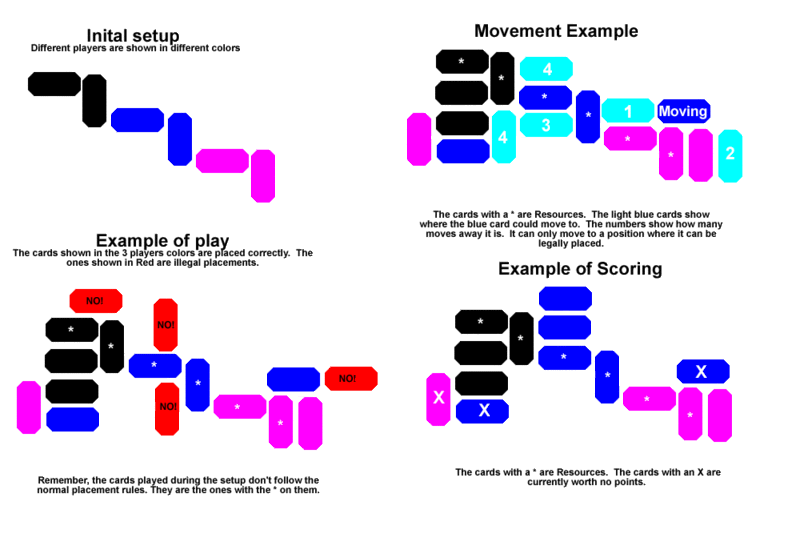
Pick who will go first. Select any two Resources from your deck. Moving clockwise around the table, each player places both their cards in a zigzag pattern (see diagram).
Note that during the initial setup you do not follow normal placement rules below.
Draw 5 cards from your deck.
Start the game.
Turn order
All players act simultaneously during each step. The steps are:
1. Everyone draws a card
2. (optional) Anyone who wants to play a species onto another area does so*
3. Everyone takes any 3 actions*
4. Check for victory
* If you take the optional move of playing a species to another person’s area, you only take TWO actions during step 3.
(Optional rule: if you have trouble keeping track of how many actions each person has taken, use a group pool of tokens. When you draw your card for the turn, draw 3 tokens from the shared pool. Then return them to the group pool as you take each action)
Actions in step 3 are as follows:
1. Discard 1 card to draw 2 cards.
2. Exchange one card in your hand for one on top of your deck (place the card from your hand on the bottom of your deck)
3. Play a Species card on an area you control
4. Play a Resource card
5. Verify a sighting of a species you don’t control
6. Move a species you control
7. Pass and do nothing
Layout
The basic placement rules apply to ALL cards. When you play a card to the table you can place it either long side to long side OR long side to TWO short sides. If there’s only one short side available, you can’t place a card there. You only need to have ONE side follow legal placement rules. It does not have to match on the other sides so long as it’s placed legally on at least ONE side.
see diagram
RULES IN DETAIL
Species and Resources
Both Species and Resources may list a climate zone on them. If there is a climate listed, that card can only touch cards that list that climate zone or list no climate zone.
For example, the card Pacific Rainforest is part of the temperate climate zone. It can only touch resources that share the temperate keyword. You can’t play it next to a card that has the Artic or Tropical keywords. It is okay to place it next to cards that have no climate zone listed (example: Brown Rat).
Whenever you place a Species or Resource card, put a token on it indicating it’s yours. Species can have more than one token on them. Resource cards cannot have more than one token on them.
Species will list resources they have to touch in order to be played. They must touch all the listed resources. They can touch MORE than the listed things as well.
Resource cards usually will have no requirements to play other than a climate zone keyword.
Verifying a species
Sometimes you will have a Species touching your Resources or Species that you don’t have a token on. Another scientist has seen the Species, but you need to verify their work before you can claim it! To verify a Species, you need to discard cards with a value greater than or equal to the value of the Species.
Once you have discarded the correct number of cards, place your token on the Species. The Species card will then have two (or more!) tokens on it and all scientists who have verified it can count it toward their points.
Example: To verify a Species with a value of 2, you need to discard 1 Species with a value of 2 or more or 2 Species with a value of 1.
Move A Species
Some species will say they can move. Unless they have the move keyword on them, you can’t move them. The Move ability will list a number with it. This tells you how far away the creature can move. A move of 1 lets it move one card away; 2 is two spaces away; etc.
The Species can only move to a new location if it could be placed there as if it came from your hand. It follow normal placement rules.
Scoring
You score points only for Species that are linked to a Resource you control. To be linked, it must touch another card your control.
When you play a species on another person’s area, you put a token on it but don’t score points for it. You can then place cards later to join it up to other areas you control.
(see diagram)
You check for victory at the end of each turn. A standard victory is 15 points, but if you want a longer game, you can pick a different goal.
SAMPLE KEYWORDS
Various species will have different abilities that do special things. Some examples of possible keywords:
Seed Disperser- This Species gives any plant touching it +1 move. (normally plants have Move=0)
Invasive- This Species can be played on top of another Species of the same type (plant, animal, etc). Discard the Species it was played on.
Parasite- This Species is played UNDER another Species card of the same type. (example: Animal) It will move with it. Place the token on top of the Species with the parasite, and place the parasite card underneath the other Species so that just the name shows.
Saprophagous- when this species is played, take a card from your discard pile and place it on the bottom of your deck. (Sometimes you find other species because they’re growing on or in another species remains!)
This is just a quick sampling of possible keywords. More can be added to reflect common roles or traits of species. Games commonly add some new keywords over time.
SAMPLE RESOURCES
Most species will require basic resources like water, cover, prey species, etc. Some specific high value species may require more specific resources. Resource cards will generate a number of Resources.
Example: Pacific Rainforest would generate more of the Water resource than a Desert. This would change what Species can be placed next to the Resource cards.
Additional resources can be added to reflect different climates and the special needs of various animals.
END OF RULES
~~~~~~~~~~~~~~~~~~~~~~~~~~~~~~~~~~~~~~~~~~~~~~~~~~~~
EDUCATIONAL STUFF
Aside from teaching kids how to identify various species, this also teaches kids some other things without beating them over the head with a lesson. Some examples of the educational aspects
· Not every species can survive in every climate or habitat
· Some species can’t exist without other species
· Some species can’t exist WITH other species.
· Some species are rare because they need a lot of resources
· Sometimes a species can’t live in an area because one small thing is missing.
· There’s more to a habitat than just animals
· Little animals and plants can be important, too
· Even gross or ugly species can be important. Cute and pretty species may not be able to exist without them.
· Scientists can share credit for discoveries
· Science works by verification of data
· Science works by collecting data to support your argument
· Sometimes scientists find data that isn’t useful to what they’re working on, but can help someone else
Additional explanation:
To make this simpler for younger kids, the Movement aspect could easily be left out... though it's surprising how much complexity kids can handle in their games. Pokemon is a HELL of a lot more complicated than it looks. It's got over 3500 different cards to build a deck from. So before you can even play, you have to narrow down your your choices of playing pieces from around 3500 to 60... but also be prepared to counter your opponent who could be using any of those 3500. Collectible card games are waaaaaaaaaaaaaay more complicated than they initially appear.
Side note:
why is the play simultaneous?
Kids hate waiting for other people to take their turn. (so do adult gamers, I often fold laundry while waiting for slow opponents to make their move). This means that kids don't get antsy waiting for their turn since turns occur at the same time. The only area where there could be argument, playing a card on someone else's area, occurs as its own separate step to prevent arguments of "But I was gonna..." "you waited too long!" "I was thinking!"
DIAGRAMS- in case the links didn't work for some reason

fenrislorsrai- Posts : 104
Join date : 2010-02-04
Age : 45
Location : Bethel, CT -

Re: Rules set with diagrams- Phylomon as map building game
Illumina Fri Feb 05, 2010 8:06 pm
Second, I really like your map-building approach to the game. After trying to design a game myself, I came to the realization that trying to emulate the gameplay of Pokemon is problematic, because it's essentially a "magical cockfighting" type of game: that is, any pokemon can do battle with any other pokemon. This is obviously not the case in reality: if you don't anticipate this, you end up with silly situations like a blue whale doing battle with a field mouse. This is awkward gameplay-wise, and you can do much better from a learning perspective. Of course, probably the most problematic thing is making a game where you win by defeating other creatures: this just isn't how the natural world works, and you have to ask yourself if that's something worth reinforcing (and it might be, because frankly that framework is fun. It's an open-ended question that needs to be considered)
So, in short, I like the basic premise you have going. I do have some questions and observations:
-Will each element (resources, creatures, etc.) be a card? I'm imagining that people will printing out these cards themselves (or will they? This is something I'd be interested to find out)... Either way, the game should ideally be reasonably portable. Unless the climate/habitat cards are really large, placing other cards/tokens on top of them is going to get really cluttered, really fast, which would detract from the experience.
-I'm not sold on using tokens to designate who owns what. Tokens aren't easily printed out, and it's another requirement you have to have in order to play, which doesn't seem that necessary.
-My biggest concern: I'm not seeing where the player interaction/competition comes in. It seems like each player owns certain portions of territory, and they're almost operating independently to create their own separate ecosystems. It doesn't look like there's much incentive to interact with resources the opponent controls. (correct me if I overlooked something)
This is a good start.

Illumina- Posts : 14
Join date : 2010-02-05
Re: Rules set with diagrams- Phylomon as map building game
davehwng Fri Feb 05, 2010 11:43 pm
davehwng- Admin
- Posts : 244
Join date : 2010-01-29
Location : UBC
Re: Rules set with diagrams- Phylomon as map building game
fenrislorsrai Sun Feb 07, 2010 6:52 pm
Whatever design we finally go with, producing a "starter" deck that downloads as one file is probably easiest way to get started. Then produce expansions so kids can customize.
As to the tokens, it depends on size of the tokens you're using. A strip of little colored squares could be added to the edge of the set downloads to get tokens. or people can just use pocket change. Flattened glass marbles are available very cheap too and are standardly used in a lot of CCGs.
Most times cards for Phylomon aren't going to have more than 2, MAYBE 3 tokens on them. If you've ever played a token heavy CCG, this is nothing. Magic the Gathering can generate crazy amounts of tokens. Vampire the Eternal Struggle, its not uncommon to have 10 tokens on a card! babylon 5 is almost as bad.
I figure the Resource cards will be same size as the rest of the cards. Some low value Species cards will just also generate Resources as they're either indicator species or keystone species. For example, you might need a Water resources to play a Beaver, but once played the Beaver itself counts as 2 Water resources. (it built a dam!) Now you've got 3 water available and can play that Pike. So you're building up your ecosystem that way. You'll either need a lot of Resource cards (which aren't worth points themselves) or build species in combos.
As to player interaction, I purposely made it so you're not going directly head to head. You're building towards a point total rather than actively bashing in the heads of the other guys animals. It's still competative, but you're less likely to have kids take it as personally. it also prevents people ganging up on one player. (which happens a lot in some games)
The main sources of player interaction right now will be playing stuff to other players areas to block stuff or moving species. (which is also blocking) Playing a species into the space means they may not be able to set up the combo they want. That place in the ecosystem has been occupied by something they didn't want.
Most of the rest of the player interaction would be based on actual card text. To use the sample Keywords I provided, the Invasive keyword might allow you to play Kudzu on someone's else's Oak Tree to destroy it. Similarly Parasite might allow you to play Black Knot (a fungus) on another player's Cherry Tree.
And more Keywords can be included to up interaction.
It's less overt competition of "I defeat you!" and more "I thwart your plans. You will have to try something else" or "I use your own items against you!" I think that set up works well to reflect the complexity of nature and research. You THOUGHT you were going to do X, but that won't work... but Y ans Z are available. Your ecosystem will have to grow and develop in a new and different direction than you planned!
Playtesting would definitely be required to work out any bugs.
fenrislorsrai- Posts : 104
Join date : 2010-02-04
Age : 45
Location : Bethel, CT -
Re: Rules set with diagrams- Phylomon as map building game
rawrchiteuthis Tue Feb 09, 2010 7:46 pm

rawrchiteuthis- Posts : 13
Join date : 2010-02-01 -
Re: Rules set with diagrams- Phylomon as map building game
fenrislorsrai Tue Feb 09, 2010 8:09 pm
Quick sample events to illustrate basic idea to incorporate those:
Hail
Hail pummels the area, destroying newly sprouted plants and fungi. Discard a target Plant or Fungus card that was played this turn.
(my garden got repeatedly pummeled by hail last year, just as everything was sprouting, thus why this sprung to mind)
DYMNAMITE!
There's mining going on nearby. The blasting disrupts the water table. All Resource cards produce one less water next turn.
I just focused on only two card types for the "base" game to keep it simple. The less you have to test in the initial test concept, the easier it is to make sure the framework is solid. Then add the bell and whistles. So test the power train, then add the moon roof.
fenrislorsrai- Posts : 104
Join date : 2010-02-04
Age : 45
Location : Bethel, CT -
Re: Rules set with diagrams- Phylomon as map building game
Illumina Tue Feb 09, 2010 8:24 pm
Illumina- Posts : 14
Join date : 2010-02-05
Re: Rules set with diagrams- Phylomon as map building game
rawrchiteuthis Tue Feb 09, 2010 9:41 pm
Illumina wrote:I like how this looks. I'd be happy to participate in playtesting, too. I took a look at Lackeyccg (which you recommended in another thread), and was really impressed. If you (or someone) has experience making a plugin for this game, that'd be the way to go. I'm not sure how difficult it is to make a plugin...
I really like the idea of this game, though it seems like it may be more oriented towards adults, rather than children (in that it seems to be more resource-control based- like Settlers of Cataan, to an extent). Which is not a bad thing! However, their would need to be gameplay elements that are addictive, like Pokemon, that would encourage children to play.
From my experience as a GM for Wizard101, I know that kids love leaderboards, online integration, and exclusives. I've also found that above all else, they love combat. Though we don't want to go down the "my blue whale ate your ferret" route, we should find a way to include combat somehow, if only in a predation sense. Say one of the resource land cards is being shrunk by natural or unnatural means - the animals would then have to "battle" to retain primary control over their environment.
Also, being able to upgrade an avatar is always a fun thing for kids. In MMO's, at least, having the best armor, weapons, etc. is a point of pride and they will spend hours in a dungeon just trying to get an epic drop. I'm not sure how we could incorporate that into a game where animal stats would mostly remain static, but we could think of a way to do so. Perhaps slight evolutionary gains? (Your animal has learned how to photosynthesize, congrats?). Though it would lean on the unrealistic side, unfortunately realisticness sometimes has to be sacrificed for fun and addictive game mechanics.
It seems like it could almost be two separate games.
rawrchiteuthis- Posts : 13
Join date : 2010-02-01 -
Re: Rules set with diagrams- Phylomon as map building game
fenrislorsrai Wed Feb 10, 2010 7:36 pm
I think we could incorporate direct combat by introducing the idea of biomass and carrying capacity. Our basic layout now is that resources will generate X resource like Water, etc. It's a bit weird if they generate stuff like Meat or Fish. (if for no other reason that kids may picture a field covered in hamburgers)
So small creatures will easily run directly off the Resource cards. They're the base of the food web.
Larger complicated critters like elk, wolves, etc need a LOT of other animals or plants to exist.
ROUGH DRAFT FOR BIOMASS/PREDATION
Larger creatures may not be able to survive on Resources alone. Under the Resource number you will see two numbers. The top number is the value available to other creatures. The bottom number is how much that creature consumes. The background behind the number will tell you what TYPE the number represents. (red, meat, Green, plant material, blue fish, etc we'll sort it out later) Creatures with the background split in two just need a TOTAL amount from either type. Creatures with a blank background can use any combination (example: Grizzly Bear shows a split background of plant and fish and a value of 3. It can do 3 plants 0 fish, 2 plants 1 fish, 1 plant 2 fish or 0 plants 3 fish)
When you play a large creature it must be touching the relevant Resources. It does NOT need to be touching enough biomass. At the end of the turn, check to see if it is touching sufficient Biomass of the appropriate type. If it meets or exceeds this, it stays where it is. If it is NOT there are two possible outcomes:
1. If it cannot find ANY of the required biomass (example: plants) discard the creature.
2. If it can't find enough (it needs 2, put is only touching one) discard the Species (or species) it is touching that provides that type of biomass.
Example: Wolf needs 2 Meat. It is only touching a Beaver which produces 1 Meat. It eats the Beaver and Beaver is discarded.
END DRAFT
From a design note, small low value species will produce lots of a type of Biomass. Mice might produce say 4. a Bear may produce 0. Why? The card represents the whole population. There's scads and scads of mice. There's probably only one bear in the area. So there's nothing that actually lives by eating bears as its primary food source.
This can also apply to herbivores. A herd of elk need a LOT more plant material available than your caterpillars do.
Having it check at end of turn for "balance" to see if there's a sustainable amount available lets us incorporate habitat degradation. Sure that wolf can live on mice for a short period... but if there's no large prey, it's going to starve.
It also lets kids have their predators or large herbivores eat other people's species. They get the fun of defeating another animal but they can't win just by eating other people's stuff. Their creatures will die off before they win!
Biomass requirements should probably only be on larger animals that are apex species. (so on the elk, but not on the Porcupine) All mid and large size predators should probably have it since they have the ability to destroy other creatures but generally can't be eaten by other things. (since nothing lives on a diet of delicious wolves)
fenrislorsrai- Posts : 104
Join date : 2010-02-04
Age : 45
Location : Bethel, CT -
Re: Rules set with diagrams- Phylomon as map building game
Illumina Thu Feb 11, 2010 1:55 am
Illumina- Posts : 14
Join date : 2010-02-05
Re: Rules set with diagrams- Phylomon as map building game
fenrislorsrai Mon Feb 22, 2010 9:36 pm
Conveniently I have both a monthly large game meet and a weekly small game meet so can run it through some initial testing to work kinks out.
fenrislorsrai- Posts : 104
Join date : 2010-02-04
Age : 45
Location : Bethel, CT -
Re: Rules set with diagrams- Phylomon as map building game
davehwng Mon Feb 22, 2010 10:15 pm
davehwng- Admin
- Posts : 244
Join date : 2010-01-29
Location : UBC
Re: Rules set with diagrams- Phylomon as map building game
fenrislorsrai Sun Mar 07, 2010 4:59 am
If you can create a template that will print text blocks only that would be ideal. It's the least drain on people's home printers!
fenrislorsrai- Posts : 104
Join date : 2010-02-04
Age : 45
Location : Bethel, CT -
Re: Rules set with diagrams- Phylomon as map building game
fenrislorsrai Mon Apr 05, 2010 6:07 pm
Movement is the most complicated aspect here and rather than having it as an stat on everything, it'll be swapped to a Keyword. Creatures that don't have the Keyword can't use the move at all. This will be split into two separate keywords.
Movement as a keyword means it moves, exactly as described here. So it would be Movement 2, for example, in the text block as a 'special ability'.
Flight basically gives it unlimited Movement PLUS some other to be determined ability. It's a nested ability. (possibly the ability to avoid predation. I shall stew further)
Great thing about keywords, you can IGNORE them. I've seen that done in some other games. The basic stats are used for the basic game. You can then add additional Keywords and complexity as players gain experience. If they're not up to playing with a specific Keyword yet, just ignore it. (Fairy Tale does this well: http://www.boardgamegeek.com/boardgame/13823/fairy-tale Carcassonne is also a good example of "ignore stuff that you're not using right now." You can play tiles from other expansions and just ignore the fancy mechanics: http://www.boardgamegeek.com/boardgame/822/carcassonne )
Other query was "how do you keep cards from mixing". CCGs both keep cards physically separated AND mix them together in many cases. The primary way to keep them from walking off is to use card sleeves.
Since Phylo is NON collectible as it's prints and play, marking them on the front (NOT the back) is also a perfectly good way to keep track. Front marking cards if frowned on with most CCGs because it destroys the value as a collectible, but since they're free to download, that's not an issue. If kids want to mark 'em with a marker or a sticker, it doesn't matter. It's not like sticking a sticker on an out of print Pokemon card.
fenrislorsrai- Posts : 104
Join date : 2010-02-04
Age : 45
Location : Bethel, CT -
Re: Rules set with diagrams- Phylomon as map building game
davehwng Tue Apr 06, 2010 7:44 pm
This post will essentially be open for comments once we're public and then hopefully the rules will continue to improve until it's ready for proper display in the gameplay section.
BTW, this is site on our server. Just going through text content for the initial launch (before we direct the phylogame.org and phylomon.org URLS TOWARDS IT). It's coming soon! I promise!
ooh - check out the cards section and toggle the photo button. It's very cool.
davehwng- Admin
- Posts : 244
Join date : 2010-01-29
Location : UBC
Re: Rules set with diagrams- Phylomon as map building game
davehwng Wed Apr 07, 2010 5:27 pm
davehwng- Admin
- Posts : 244
Join date : 2010-01-29
Location : UBC
Re: Rules set with diagrams- Phylomon as map building game
Cubist Fri Apr 09, 2010 11:46 pm
First, where do we put these half-symbols?
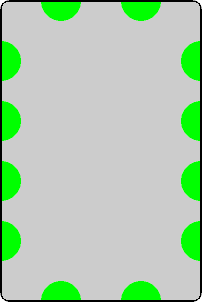
The green bits indicate where those half-symbols can go. I say "can" rather than "must" because I see no reason not to allow some of those spots to remain empty; some cards could have half-symbols in all 12 spots, some could have only 4 or 3 or even just 1, and so forth. I'm thinking that this could be useful to help the game simulate inter-species compatibility; the fewer actual half-symbols a card has, the more difficult it's gonna be for a player to put that card into his 'network', right?
And what does a "half-symbol" look like?
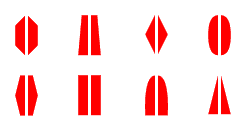
The idea being, you take simple geometric forms (an ellipse, a rectangle, etc) and you split them right down the middle, thus generating a right half and a left half. Like matches like; a half-ellipse can only match up with another half-ellipse, and so on.
How can this work in play?
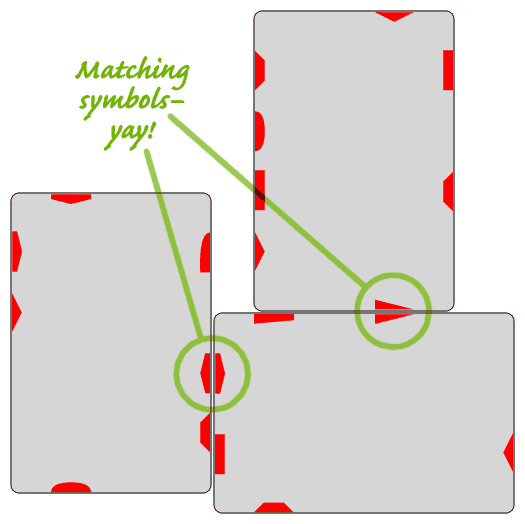
In this example, the two bottom-most cards have a matching set of half-hexagons. The bottom right card has a half-rectangle which very much does not match the half-hex it touches on the bottom left card, but that's okay; the matching half-hexagons make for a good, solid pair, and that's the important thing. As for the two right-most cards, they've got a pair of matching half-triangles, so they're good to go.
Note that if Phylo does use this matching-half-symbols schtick, it would be a Very Good Idea to also put in a rule about "no cards can overlap -- all parts of a card must be plainly visible".
At its most elementary level, Phylo can ignore the half-symbols -- they're just decoration -- and just use whatever simple card-placement rules we feel like making. But a more-sophisticated version of the game could take notice of the half-symbols, adding a new dimension to strategy and tactics.
Comments, people?
Cubist- Posts : 43
Join date : 2010-02-07
Re: Rules set with diagrams- Phylomon as map building game
davehwng Sat Apr 10, 2010 12:06 am
I will put it up on the website though (maybe a week after it's public so that there is some good traffic going there), because one of things we can always test out, is whether the project has enough pull to attract a programmer that could tackle this nuance.
One way to possibly get around this, is to just have a limited number of standard borders (in between the two extremes of having just the black border or the other extreme having complete fluidity in choosing what symbols and where). Anyway, that's one simplified option.
The other thing worth thinking about is the central idea of whether we have enough data already on the card? i.e. do the placement of symbols add information about the organism, or is it more a device to enrich gameplay? And, of course, whether this kind of discussion matters anyway (i.e. it's cool, just do it!)
It's funny. You mentioned this could be something for more advanced players, but I actually thought it might be a way to make the game more playable for younger players (i.e. players <6 years old who haven't quite figured out the reading bit yet!)
Anyway, the website is very very close. I suspect on monday I'll be directing the phylogame.org URL to the site, but do check out http://phylogame.msl.ubc.ca and have a look round. I think it's pretty cool.
davehwng- Admin
- Posts : 244
Join date : 2010-01-29
Location : UBC
Re: Rules set with diagrams- Phylomon as map building game
davehwng Thu Apr 22, 2010 1:59 am
davehwng- Admin
- Posts : 244
Join date : 2010-01-29
Location : UBC
Re: Rules set with diagrams- Phylomon as map building game
davehwng Thu Apr 22, 2010 2:47 pm
http://phylogame.org/2010/04/22/ecosystem-building-game/
davehwng- Admin
- Posts : 244
Join date : 2010-01-29
Location : UBC
Re: Rules set with diagrams- Phylomon as map building game
Wootfish Thu Apr 22, 2010 5:54 pm
I haven't had a chance to read this yet, but its length alone makes me think that it would be a very good idea to provide a "printable version" of the rules that's better-formatted for printing out. For instance, the hyperlinks would be removed so the text can cover more of each page, meaning fewer pages if paper would be needed.davehwng wrote:Check this out. I think this set of rules is ready for some serious testing.
http://phylogame.org/2010/04/22/ecosystem-building-game/
Last edited by Wootfish on Thu Apr 22, 2010 7:57 pm; edited 1 time in total

Wootfish- Posts : 88
Join date : 2010-04-15
Location : A little slice of your consciousness.
Re: Rules set with diagrams- Phylomon as map building game
fenrislorsrai Thu Apr 22, 2010 7:29 pm
I am confused by one thing in the rewrite:
As well (and this part is VERY IMPORTANT), players can also add strategic value to their species cards if they have actually seen the organism in the wild (say, as documented by a photo on their digital camera). This allows the player to MOVE the organism without using up one of the three actions.
Is this indicating that to use this option kids should actually show the other player a picture of the critter they photographed in the wild? Or is this referring to something that got edited out in one of the drafts?
If this is an actual "show me a photo" I am AGAINST having this in the main rules. I'd be fine with having this as a variant (like Field Trip Rules variant, suggested for use after kids have gone to the zoo/park/etc with class). But I don't like having that as a main rule as it gives an unfair advantage to wealthier kids that own a phone or camera. Since this is intended to be educational and be used in classrooms, penalizing poor kids with a built in rule seems terribly unfair.
If this is just a holdover from a different draft and its unconnected, it just needs tidying.
fenrislorsrai- Posts : 104
Join date : 2010-02-04
Age : 45
Location : Bethel, CT -
Re: Rules set with diagrams- Phylomon as map building game
davehwng Thu Apr 22, 2010 8:06 pm
As well, good point with the accessibility on the "taking photo" rules (I think the goal is to somehow get kids to want to go outside as well - maybe we can add a "seen it" box on the card or something.
The idea of offering variations to the rules seems to be a good one (someone else has suggested that the current rules might also be usable for younger kids if you remove the Environmental Challenge and Movement aspects - kind of like a straight up linkage game).
davehwng- Admin
- Posts : 244
Join date : 2010-01-29
Location : UBC
Re: Rules set with diagrams- Phylomon as map building game
naturalismus Thu Apr 22, 2010 8:34 pm
1. I don't like the "end of game" but don't have a good idea, too.
2. I think the starting player has a big advantage because habitat cards can't just be played next to other habitat cards. If the first player plays cards with CLIMATE values the second one just doesn't have that's pretty unfair.
3. I think it would be good to create multiplayer-compatible rules.
Overall I really like the rules.

naturalismus- Posts : 38
Join date : 2010-02-22
Re: Rules set with diagrams- Phylomon as map building game
Wootfish Fri Apr 23, 2010 1:08 am
--design--
- If we're going to require cards to be lined up, it seems like an absolute necessity to mark the edges of the cards, as Cubist first suggested at the top of this topic's second page. In my opinion, color-coded marks would be the best way to make this work, instead of geometric shapes. Give each qualifier its own little space on the card, and with a bit of mirroring we can make color-coding work for all the angles and alignments this ruleset requires. The little terrain indicators are definitely good, and should be kept, but by themselves they could prove to be kind of ambiguous. This color-coding would make it easier to visualize links between cards, making the concept easier for people to pick up.
- I can't see a reason for requiring players to only place cards adjacent to other cards of their own. It seems like it would make more sense to allow them to place cards anywhere. Is there some good reason for this rule that I'm missing?
- Along with the objections fenrislorsai raised (which I agree with 100%), if someone can do the same thing multiple times in a turn, and moving a creature you have a picture of doesn't use up one of your 3 actions, what's to stop you from moving it over and over and over and over? Removing the iteration counter creates an infinite loop. That ain't good.
--nitpicks--
- Step 2 under "Basic Play" doesn't specify if an action can be repeated or not -- for instance, if you can discard 3 cards in a turn, or only one. The example seems to indicate that actions can be repeated, but this should be explicitly stated.
- If I'm not mistaken, step 4 under "Basic Play" should say "either person's", not "each person's".
- Under "Example of Play", "You can play another habitat card" is in bold, and "You can play a species card" is in italics. It would probably make more sense to have them both in one or the other.
- The note under "Other Keyword Examples" for invasive species is slightly confusing. It notes at the end that placing an invasive species over another species uses up an action. However, placing a species uses up an action anyway. So does this mean that invasive species use up two actions, or is the note just redundant? Either way, it should be reworded to be less ambiguous.
I agree with dave -- once the species cards get their content filled in, it seems like this ruleset is ready to undergo some serious testing.
Wootfish- Posts : 88
Join date : 2010-04-15
Location : A little slice of your consciousness.
Page 1 of 2 • 1, 2
Similar topics» Proposed Rules for Trumps-type game
» Deck building
» Progress on Phylomon.
» Phylomon =Xeko
|
|
|